
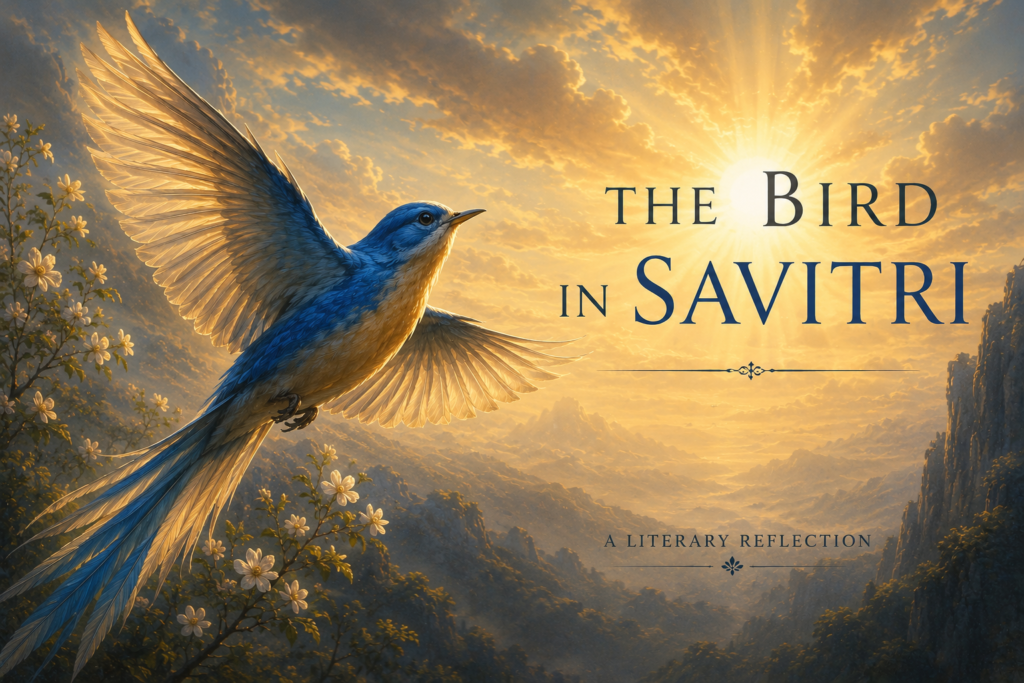
I have personally been fascinated by the bird theme in my poems in relation to freedom. It could be human freedom or the freedom of the bird itself from the cage, characterized by a joyous flutter and the union with the sky. Probably, that is why, one of the motifs I have noticed in Savitri is the bird, which, presented through surreal imagery, assumes varied characters and purposes. While references to the bird have occasionally been made in literal terms as well, this post highlights some of its symbolic characterizations.
Her high passion a blue heaven’s equipoise.
As might a soul fly like a hunted bird,
Escaping with tired wings from a world of storms,
And a quiet reach like a remembered breast,
In a haven of safety and splendid soft repose (Book 1, Canto I, p. 15)
Savitri is one who gives refuge to those fleeing storms, with the intensity of the flight conveyed by the force of an exhausted “hunted bird” that lands in a safe haven. This phenomenon could also be likened to the calm and comfort a being would experience in the Mother’s1 embrace after enduring innumerable births, or perhaps to the sweet drift into a mystic sleep after undergoing immense labour or torment.
The white-fire dragon-bird of endless bliss
Drifting with burning wings above her days (Canto II, p. 16).
Dr. Reddy explains that the dragon-bird symbolizes “physical immortality”2 that always shielded Savitri, a “missioned child.” What strikes out is “endless bliss” other than imagining what a “white-fire dragon bird” would look like. The nature of the shield does not suggest any hard object intercepting any fatal blow or adversity but one that radiates softness that someone enveloped by bliss would feel.
And lulled by whispers of that lucid air
Take dream-hued rest like birds on timeless trees
Before they dive to float on earth-time’s sea (Book 2, Canto 1, p.96)
In the above lines, the reference to the bird imagery comes in the context of “thoughts’ ” transition from the subtle matter3 to earth-nature. The movement from the plane of subtle matter to the physical world is downward–on to the “earth-time’s sea.” Prior to that, thoughts perched on “timeless trees.”
Another movement is noticeable in the context of the Kingdoms and Godheads of the Greater Mind, where the “heaven-bird” is the metaphor for “feeling” that “answers Truth’s call” (Book 2, Canto 11, p. 264). Similarly, the ascension of Savitri’s spirit has been expressed through a soaring bird:
Into those heights her spirit went floating up
Like an upsoaring bird who mounts unseen…(Book 11, p. 678).
Savitri’s descent into earthly life is depicted as taking place within a gentle receptacle:
Amidst the headlong rapture of her fall
Held like a bird in a child’s satisfied hands,
In an enamoured grasp her spirit strove
Admitting no release till Time should end,
And, as the fruit of the mysterious joy,
She kept within her strong embosoming soul
Like a flower hidden in the heart of spring...(Book 11, p. 711).
Further, in the Epilogue Return to Earth, Savitri’s “earthly morns” are compared to a bird’s “outwinging from a bright home”: Outwingings of a bird from its bright home, Her earthly morns were radiant flights of joy. Imagine a bird in a “bright” nest. When she flies out, her wings carry that sparkle, suggesting a radiant flight. So, when Savitri awakes from the trance, her life in the physical world is luminous and transformed.
The above-cited passages are a few among many bird references in Savitri. What other dimensions of the bird motif might emerge from the unexplored references? For now, the bird appears in many forms: hunted, protective, resting, soaring, descending, and radiant. More than a symbol of freedom alone, it appears to serve as a vehicle through which Sri Aurobindo expresses movements of consciousness.
- Refers to Mirra Alfassa, the Mother. ↩︎
- https://sacar.in/wp-content/uploads/2023/03/Savitri1.pdf, p. 179. ↩︎
- Shri M.P Pandit explains, “Crossing beyond the borders of the physical world, Aswapathy enters into a realm of wonder and delight—the world of subtle matter. This world overtops our physical world. Beautiful, symmetrical in forms, with senses subtler and more far-ranging than the physical ones, this realm is the shining origin of the world below. All here on earth follows the lines already mapped out there in the subtle world above.” ↩︎